




Latest Entries

National Nutrition Month & Workplace Wellness

Bad habits are like a comfortable bed: easy to get into but hard to get out of; and at work, it’s easy to slip into poor food choices…

  • …a sales rep stops by with doughnuts for the entire office…
  • …you celebrate a co-worker’s birthday with cupcakes…
  • …you attend a catered business event, etc…

About National Nutrition Month

March is National Nutrition Month!

National Nutrition Month® is a nutrition education and information campaign created annually in March by the Academy of Nutrition and Dietetics. The campaign focuses attention on the importance of making informed food choices and developing sound eating and physical activity habits.

The theme for 2016 is “Savor the Flavor of Eating Right,” which encourages everyone to take time to enjoy food traditions and appreciate the pleasures, great flavors and social experiences food can add to our lives. How, when, why and where we eat are just as important as what we eat. Develop a mindful eating pattern that includes nutritious and flavorful foods — that’s the best way to savor the flavor of eating right!

How do most working adults get off track with their nutrition?

When we have busy schedules, people start looking for convenience. This increases the frequency of eating out, especially fast food. If meals and snacks are not planned, we tend to eat more junk food.

How does the workplace influence how people eat?

Co-workers can have a positive or a negative influence on your eating habits. If someone is always bringing in doughnuts, it is easy to get tempted. You may also get into the habit of going out for lunch every day.

Steps that Adults Can Take to Eat Healthier

A little planning goes a long way.

Set aside some time during the week to do some planned grocery shopping. Then cook up a bunch of extra meals on your day off. Use a crock pot/slow cooker to make easy, healthy meals. You won’t need to eat out after a long, tiring work day if you have good food waiting for you at home! Plan and pack a healthy snack and lunch, and always make sure you have a refillable water bottle on hand.

Employee being offered junk food at work

Fostering Wellness at Work with Better Food Choices

The following are some ideas to help you and your colleagues stay on track with healthier eating while at work.

  • Create a work place that fosters healthy eating.
  • Have healthy snacks in the break room.
  • Have a discussion with co-workers about not buying/bringing candy or sugary snacks.
  • Stay active through the day.
  • Drink an adequate amount of water.
  • Bring your own lunch and snacks.
  • Limit eating out.

5 Quick, Easy Meal Ideas

The following are some quick, easy meal ideas that you can try on your own at home:

  1. Healthy chili with beans with a green salad and baked sweet potato
  2. Stir-fry with brown rice, lean protein and plenty of colorful vegetables
  3. Whole grain pasta with lean protein and plenty of colorful vegetables
  4. Grilled cheese sandwich on whole grain bread with a hearty vegetable soup
  5. Taco bar – black beans, salsa, guacamole, olives, low fat cheese. Add vegetables such as baby spinach, grilled zucchini, onions and peppers

8 Work-Friendly, Healthy Snack Ideas

healthy meal at work

Long day at work? Here are some healthier snack options to reach for!

  1. Home made trail mix: nuts, seeds, dried fruit
  2. Whole grains crackers with low fat cheese
  3. Apple or banana with peanut butter
  4. Any fresh fruit + handful of nuts
  5. Vanilla Greek Yogurt  topped with berries
  6. Veggies  and/or baked pita chips with hummus
  7. Whole grain mini bagel with peanut butter
  8. Black bean dip with baked tortilla chips

About Parul Kharod, MS, RD, LDN

Parul is a Clinical Dietitian in Outpatient Nutrition Services at WakeMed Cary Hospital. For information related to diet and nutrition, or to speak to one of our licensed, registered dietitians, contact Outpatient Nutrition Services today. Insurance coverage and costs may vary.

Share

Help Set Priorities for Improving Wake County’s Health, Well-being

Wake County residents are urged to attend a meeting next month to help set the top health priorities for their local communities over the next three years.

On Tuesday, March 8, residents will review the results of public outreach efforts conducted last year through the Community Health Needs Assessment (CHNA). Then, citizens will prioritize the findings to reflect what they consider to be the greatest needs in their communities.

Meetings will take place simultaneously at 6 p.m. at five different locations across the county:

  • NC State University, Talley Student Center (2610 Cates Ave., Raleigh) (Spanish language translation services will be available at this location.)

­

  • Northern Wake County – New Bethel Baptist Church (605 E. Young St., Rolesville)
  • Southern Wake County – Fuquay Varina Baptist Church (301 N. Woodrow St., Fuquay-Varina)
  • Eastern Wake County – Eastern Regional Center (1002 Dogwood Drive, Zebulon)
  • Western Wake County – United Way of the Greater Triangle (2400 Perimeter Park Drive, Morrisville)

These events are free and open to the public. Dinner will be served prior to the start of the meetings. Residents are encouraged to register at www.wakegov.com/wellbeing

WakeMed CEO Donald Gintzig is co-chairing the 2016 Community Health Needs Assessment initiative.  This assessment is conducted every three years in partnership with the county and other health organizations to determine how well residents of Wake County are currently and to identify opportunities for improvement in the future.  As Wake County’s largest and only hospital system that is based in Wake County, the results of this initiative are especially important to WakeMed because we are constantly searching for ways to better serve the residents of our home county.  Review the 2013 Community Health Needs Assessment report.

Share

Improving Cardiovascular Care for Patients in Wake County

Heart healthy older coupleWhen it comes to cardiovascular care for patients in Wake County, NC, WakeMed is a proven leader.

Our heart and vascular physicians are continually growing and developing new ways to improve heart care and quality of life for our patients – especially those who have faced limited cardiovascular treatment options in the past.

In an effort to address these chronic, and often complex heart issues, in 2014, WakeMed cardiologist, Dr. Islam Othman, developed the Complex Percutaneous Coronary Intervention/Chronic Total Occlusion (PCI/CTO) Program.

About the Complex PCI/CTO Program

The PCI/CTO Program is aimed at helping heart patients who have chronically occluded (blocked) coronary arteries, or who have severe coronary artery disease. This highly specialized, non-surgical procedure is minimally-invasive and uses state-of-the-art devices to effectively treat coronary blockages, restore blood flow, and reduce/eliminate symptoms of coronary artery disease.

Who is a candidate for the Complex PCI/CTO Program?

  • Patients whose chest pain can’t be managed with medication
  • Patients for whom surgery is NOT an option
  • Patients who need to have blocked arteries treated before having heart valve replacement surgery (TAVR)

A Non-Surgical Approach to a Better Quality of Life

Since it was founded in 2014, Dr. Islam Othman has helped the WakeMed PCI/ CTO Program evolve into the most successful program of its kind in North Carolina.

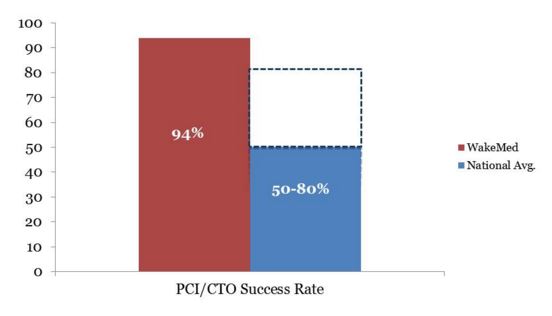
Dr Othman’s comprehensive approach within the program has resulted in a 94% clinical success rate – a rate that stands well above the national average of 50% to 80% – and in keeping with WakeMed’s mission to provide the highest quality cardiovascular care in the region.

WakeMed Complex PCI/CTO Program Success

At the end of the day, the WakeMed Complex PCI/CTO Program is about improving cardiovascular care so that patients can have a better quality of life. It’s a patient-centered approach, as Dr. Othman explains:

Restoring quality of life for patients is our primary goal. Many of these patients have been told they have no further options for treatment, and their ability to enjoy life really suffers. Seeing our patients feel better is incredibly rewarding.

About Islam Othman, MD, FACC

Dr. Islam Othman is a board certified general as well as Interventional Cardiologist with WakeMed Physician Practices. A 2015 recipient of the Triangle Business Journal’s prestigious 40 Under 40 award, Dr. Othman specializes in adult cardiovascular diseases, cardiovascular disease prevention, heart failure management, interventional cardiology, general cardiology, and nuclear medicine. His areas of expertise include: echocardiography, transesophageal echocardiography, nuclear imaging, stress imaging, coronary angiography, and complex coronary interventions.

Share

Hip Pain 101 Seminar – Thursday, March 3rd

Hip pain is commonly caused due to aging or as the result of a fall. However, there are other reasons why hip pain exists, such as: tendonitis, bursitis, or arthritis, to name a few.

Join us Thursday, March 3, 2016 for a FREE seminar on hip pain where we will discuss these and other issues related to causes, symptoms, and relief for hip pain.

Led by Wake Orthopaedics surgeon, Dr. Timothy Harris, the Hip Pain 101 Seminar will address some of the following topics:

For more in-depth answers to questions about hip pain, hip injuries, hip replacement, and more – sign up to attend our FREE Hip Pain 101 Seminar. Additional details are below.

About Timothy E. Harris, MD

Dr. Timothy E. Harris is a board certified, fellowship trained orthopedic surgeon with Wake Orthopaedics. Dr. Harris specializes in the diagnosis and management of hip and knee arthritis, fractures and adult musculoskeletal deformity. He performs fracture and trauma surgery for the extremities, pelvis and spine and adult reconstructive surgery for post-traumatic and degenerative conditions.


WakeMed Hip Pain 101 SeminarHip Pain 101 Seminar

Thursday, March 3, 2016

10:00am – 11:00am

WakeMed Raleigh Campus
Andrews Conference Center
3000 New Bern Avenue
Raleigh, NC 27610
Map & Directions

REGISTER

Share

Crawling and Above: Infant Nutrition Seminar

WakeMed Birth and Parent Education is excited to offer:

Crawling and Above: Infant Nutrition Seminar

This seminar is aimed at families of infants approaching 4 months and beyond. It will be facilitated by an International Board Certified Lactation Consultant Examiner (IBLCE), and it will focus on the following:

  • Breastfeeding for the first year
  • American Academy of Pediatrics (AAP) guidelines to introducing solids
  • Food textures
  • Choke hazards
  • Choking maneuver
  • Identifying allergies
  • Making baby food
  • Feeding challenges
  • And more!

Learn more about the Crawling and Above: Infant Infant Nutrition Seminar, and register to attend this event below.


Infant Nutrition

Details About The Seminar

  • When: Saturday, March 26, 2016
  • Time: 10am – 12pm
  • Cost: FREE! However, Registration is required.
  • LocationWakeMed Cary Hospital, Cary Conference Room | 1900 Kildaire Farm Road, Cary, NC 27518

REGISTER HERE

Share

Orthopaedic Urgent Care or Emergency Department?

Injured knee, sprained ankle, or possible broken bone? Where is the best place to get the care you need? Here’s a quick guide to help you figure out where to go in the event of an orthopaedic injury. Knowing where to go can save you significant time and money.

runner with ankle injury

When Should I Choose Urgent Care for an Orthopaedic Injury?

The vast majority of orthopedic injuries can be safely treated at an urgent care. As long as there isn’t severe arm or leg deformities, excessive bleeding, or life threatening concerns, urgent care is the best option for treatment.

Through a collaboration with Wake Orthopaedics and WakeMed Urgent Care, patients have an affordable and efficient alternative to the ER for the most common orthopaedic injuries, including:

  • Sports injuries
  • Sprains, strains, & discolorations
  • Fractures
  • Ligament tears
  • Cast or splint issues
  • Cuts/lacerations
  • Painful, swollen joints
  • Pediatric injuries

WakeMed Urgent Care has two locations, in Cary and Raleigh. Our partnership with Wake Orthopaedics allows full-time orthopaedic urgent care coverage for patients needing orthopaedic care for injuries every day, from 8am – 8pm.

When Should I Go to the Emergency Room for an Orthopaedic Injury?

If you think that your injury may be life-threatening ALWAYS choose the emergency department for care. The emergency department is a better choice for more severe orthopaedic injuries, and it offers better resources for treatment if:

  • Your arm or leg is severely crooked
  • A bone has broken through the skin
  • There has been significant blood loss
  • There are other complicating factors (ex: multiple injuries, such as: falling from heights or motor vehicle collisions)

What About Children & Orthopaedic Urgent Care?

For children with significant injuries, such as larger cuts or angulation deformities of their arms and legs, the emergency room offers appropriate sedation and the most comfortable and stress-free treatment environment. Also, unlike urgent care locations, emergency departments are open 24/7 and feature the widest range of services and access to medical specialists.

Visit WakeMed Urgent Care to learn more about our orthopedic urgent care and all of our other urgent care services. For emergency department wait times, locations, and directions, visit WakeMed.org. Wake Orthopaedic providers cover WakeMed North, Brier Creek Healthplex, and the Garner Healthplex emergency departments Monday through Friday until 9:30pm and Saturday/Sunday until 5pm.

About Mark L. Wood, MD

Dr. Mark Wood is board certified in Orthopedic Sports Medicine at Wake Orthopaedics with a practice that is focused on knee and shoulder injuries and disorders. Online appointment requests and information about the five convenient office locations are available at WakeOrtho.com.

Share

Vertigo: A Dizzying Diagnosis

Have you ever done something that gave you the sensation of feeling light headed or dizzy? Recently, UNC basketball coach, Roy Williams, suffered a vertigo attack, but Coach Williams isn’t alone.

According to the National Institute on Deafness and Other Communication Disorders (NIDCD), there are more than a dozen different types of balance disorders. Of these balance disorders, Benign Paroxysmal Positional Vertigo (BPPV) is the most common, causing roughly 50% of dizziness in older adults.

Vertigo is More Common Than You’d Think

At WakeMed, our Ear, Nose and Throat (ENT) specialists commonly see patients with suspected vertigo. In fact, according to Dr. Michael Ferguson, an ENT doctor and director of WakeMed Physician Practices ENT Head & Neck Surgery,

Very few patients with a chief complaint of “dizziness” actually have true vertigo.

Fortunately, certain types of vertigo can often be treated reliably and on the spot, helping a large percentage of these patients. The condition can also go away on its own. Below, we address some of the most common causes, symptoms, and treatment for vertigo.

patient with vertigo

What is Vertigo?

Vertigo is a very specific sensation that the room is spinning around in circles. If you look at someone’s eyes during an episode, you can actually see the eyes darting back and forth (nystagmus).

Can vertigo have multiple causes?

YES. Vertigo can be caused by a number of things. The most common cause is BPPV. Other causes include:

  • Inflammation of the inner ear (labyrinthitis or vestibular neuronitis)
  • Ménière’s Disease (associated with ringing in the ears/hearing loss)
  • Head trauma
  • Brain tumors
  • Strokes
  • Migraines

Is vertigo more common in older adults?

YES. Overall incidence of vertigo is between 5-10%, but this increases to roughly 40% in patients over the age of 40. In other words, the older you get, the more likely you are to experience an episode of vertigo.

Can stress or weather trigger a vertigo attack?

YES & NO. Dizziness/vertigo isn’t typically associated with weather changes or stress. However, vertigo IS oftentimes confused with general dizziness, imbalance, or a sense of passing out – and that can certainly be triggered by a drop in blood pressure (orthostatic hypotension) related to stress or over-activity.

When should I see a doctor for my symptoms?

IT VARIES. The following are examples of when you should DEFINITELY seek medical attention:

  • Your vertigo symptoms are consistently persistent for an extended period of time (hours)
  • You experience intermittent symptoms that tend to recur
  • You experience other symptoms, such as: hearing loss, vision changes, or headaches

Is there anything I can do to manage my vertigo symptoms at home?

YES. The Epley Maneuver is a series of head movements  to relieve vertigo symptoms, and it can be performed at home.

Dr. Ferguson breaks it down further:

Imagine the balance part of the inner ear is like three hula hoops filled with motor oil. The three hoops are all oriented in three different planes, and together they act like a gyroscope. The fluid inside the hoops shifts when you turn your head, and that fluid shift triggers the little nerves lining the inside of the hoops (called hair cells) to tell your brain which direction your body is moving.

Debris or deposits can sometimes break lose in these hoops (the semicircular canals), so when you turn your head a certain direction, they float through the hoops creating all sorts of havoc and telling your brain you are whipping around in circles even though you aren’t. The Epley maneuver is a way to flush those flecks of debris (otoliths) out of the semicircular canals. It’s exactly like the little maze game you played as a kid where you try to get the little steel ball through the maze and drop it into the hole.

About Michael Ferguson, MD

Dr. Michael Ferguson, is an ear, nose, & throat (ENT) doctor and director of WakeMed Physician Practices ENT Head & Neck Surgery. His clinical interests range from pediatric ENT, to sinus disease, thyroid surgery and cancers of the head and neck. For additional information on vertigo, or to address other ENT-related issues, schedule an appointment with Dr. Ferguson today.

Share

2016 I Heart to Play Day at Marbles Kids Museum

Join WakeMed Children’s Hospital as we partner with Marbles Kids Museum tomorrow, February 13th for I Heart to Play Day!

About I Heart to Play Day

Bring your family, and explore fun ways to get your heart pumping this Valentine’s Day weekend. Join in on a jump rope jam and dynamic dance party, and figure out fun fitness challenges throughout the museum. Learn how to make heart-healthy decisions that your taste buds will appreciate. Visit the build-your-own snack stations, taste samples and take home recipes.

Details are below:

What: I Heart to Play Day at Marbles
When: Saturday, Feb. 13, 2016 | 11am to 5pm
Where: Marbles Kids Museum | 201 E Hargett St, Raleigh, NC 27601
Cost: Cost of admission

I Heart to Play Day Special Guests

11:00am – 11:45am: Stage Door Dance – Valentine themed story & dance workshop in Curiosity Square
11:00am – 2pm: Healthy Snacks with WakeMed dietitians
12:00pm – 1pm: Peck’s Taekwondo Amerikickers – Demo followed by a skill session
1:30pm – 2:30pm: Apex Skip-its – Synchronized jump rope team
3:00 – 4:30pm: Cirque de Vol Studios – Aerial silks demo

I Heart to Play Day is FREE with museum admission and presented in partnership with WakeMed Children’s Hospital. Visit the Marbles Kids Museum website for additional information on museum admission and hours.

Share

Healthy Hearts for Women – Protect Your Heart Health

Too often, heart disease is thought of as a male-only disease. However, women of all ages and backgrounds are just as much at risk. In fact, heart disease is the leading cause of death in women in the United States.

By raising awareness about the importance of heart health, women can be empowered to take charge of their heart health. Our own WakeMed Heart & Vascular physicians, Dr. Sahar Amery, and Dr. Bhavani Balaravi, weigh in on some of the simple changes women can make to love their hearts – starting with prevention.

woman holding red heart

Risk Factors for Heart Disease in Women

Loving your heart starts with prevention. Did you know that a woman’s risk for heart disease nearly DOUBLES after menopause?

Both Dr. Amery and Dr. Balaravi stress the importance of making lifestyle changes to improve your health – well before the onset of menopause. You can begin by maintaining a normal weight, exercising regularly, and eating a healthy, balanced diet.

Leading a healthy lifestyle may prevent many common heart risk factors from ever occurring. Women need to take note of their own personal risk factors, and take steps towards improvement because left alone – one risk factor can have a domino effect, leading to an increased chance of heart disease.

Common risk factors for heart disease in women include:

  • Diabetes
  • High blood pressure
  • Smoking
  • Menopause

Women’s Hearts Are Different

We’ve all seen the movies where the man grabs at his chest dramatically before collapsing to the ground…but heart attacks don’t always happen this way. This fact is something the American Heart Association continues to emphasize, citing that while some heart attack symptoms are shared between men and women, many women experience completely different symptoms.

Dr. Balaravi explains:

Many women don’t know the facts about heart attacks, and since they have nonspecific symptoms, they just don’t think they could be having a heart problem and may not seek medical care.

Heart attack symptoms in women may include:

  • Shortness of breath
  • Anxiety
  • Sleep disturbances
  • Indigestion/Gas pain
  • Upper back/Shoulder Pain

We invite you to join us as we celebrate American Heart Month and women’s heart health. Below are a couple of free, upcoming events that we encourage you to take part in.

Learn more about these and other Heart Month Events that WakeMed is participating in.


Heart Healthy Events for Women

Love Your Heart
What
: Did you know that shopping can be a great form of cardio? Cameron Village and WakeMed Heart Center are partnering to increase heart disease awareness among women.
When: February 1- 14th
Where: Participating Cameron Village Stores | Cameron Village | 2034 Cameron Street, Raleigh, NC 27605
Learn more about this event here!

FREE Seminar
What
: Ladies, join us for an informative talk on Hormones, Hot Flashes and Heart Disease
When: Thursday, February 18th, 6pm
Where: WakeMed North | Conference Room | 1000 Falls of Neuse Rd., Raleigh, NC 27614
Register for this event here!

Share

Fall In Love with Chocolate for Better Heart Health

Can one chocolate a day really keep heart disease at bay? As we celebrate Heart Awareness this month, we’re giving you one more reason to fall in love with chocolate: it may actually help your heart!

Heart Health and Chocolate

The health benefits of chocolate have been known for centuries, but the true hero behind the ‘chocolate mask’ is cacao. The cacao bean is produced by the cacao tree, Theobroma cacao, which is native to South America. The tree bears fruit (or pods), and within each pod is roughly 20-40 cacao beans.

Considered a superfood, cacao naturally has:

  • Antioxidants and dietary fiber
  • The highest sources of flavonoids and polyphenols
  • Tons of minerals: magnesium, iron, potassium, zinc, & calcium
  • Monosaturated fat (like that found in olive oil)

Why does this matter?

All of the elements found in cacao help improve heart health by reducing inflammation in the body and eliminating damaging free radicals. The flavonoids and polyphenols in cacao can also help lower blood pressure, prevent blood clots, and improve blood flow to the brain and heart.

chocolate heart

Sweet Ways to Add a Little Chocolate to Your Diet

The following are some descriptions of various types of chocolate and cacao products; it is NOT a list of recommended types of chocolate! *Special thanks to WakeMed dietitian, Parul Kharod, for her contributions to this portion of the article.

COCOA LIQUOR

  • What it is: paste made from ground, cacao beans
  • Where you’d find it: baking chocolate, chocolate bars

COCOA BUTTER

  • What it is: fat that remains after cocoa solids have been removed from cocoa liquor
  • Where you’d find it: cocoa butter (and other skin care products), some baked goods

COCOA POWDER

  • What it is: the cocoa solids that are left after cocoa butter is removed from the liquor
  • Where you’d find it: pudding, brownies, hot chocolate

CHOCOLATE BARS

  • What it is: made by mixing cocoa liquor + cocoa butter + other ingredients for flavor and taste (ex: sugar, milk, nuts, etc.)
  • Where you’d find it: any chocolate candy bars

MILK CHOCOLATE

  • What it is: chocolate + condensed milk/powdered milk + sweeteners
  • Where you’d find it: chocolate bars, chocolate milk

WHITE CHOCOLATE

  • What it is: cocoa butter + sweeteners + dairy ingredients *(white chocolate contains zero cocoa, so it doesn’t have any health benefits)
  • Where you’d find it: candy, beverages

Love Your Heart A LOT; Love Your Chocolate A Little

If you love your heart, you’ll love your chocolate in moderation. While there is no set standard or daily recommendation for how much chocolate you should consume (bummer), most researchers agree that you should set the bar: dark. WakeMed dietitian, Parul Kharod, recommends that you limit yourself to approximately 1 oz. of dark chocolate daily. The higher the cacao content of the chocolate bar, the better it is for your health. Look for bars containing 70% cacao or more.

Why?

As a general rule, darker chocolate typically contains more cacao and therefore more flavonoids than other varieties of chocolate. So, before you go for the candy grab, be mindful of the type of chocolate you’re reaching for!

If you would like help from Parul or another dietitian to start off on the right track, learn more about our outpatient dietitian services.  Many times these consultations are covered by insurance and are available to you at no additional charge.

Share